
Imagine investing three months of your marketing budget into building an outbound campaign. Your design team crafts flawless assets, your copywriters pen hyper-personalized sequences, and your product team sets up an irresistible offer. You load your target list into your marketing automation platform, hit send, and wait for the leads to roll in.
Instead, you are met with silence.
Within forty-eight hours, your dashboard shows an alarming surge in hard bounces. Your open rates crater to single digits. By the end of the week, your domain reputation is damaged, and your emails are landing directly in the spam folder—not just for this campaign, but across your entire enterprise.
What went wrong? The culprit isn’t your copy, your design, or your product. It is your data.
In the B2B landscape, your data is the foundational infrastructure of your entire go-to-market engine. Yet, modern marketing teams routinely treat database health as an afterthought. According to industry benchmarks, B2B data decays at an average rate of 2.5% to 3% every single month. That means up to 30% to 36% of your customer and lead database goes cold, inaccurate, or entirely dead every single year.
This comprehensive guide serves as an actionable playbook for data marketing teams, demand generation managers, and sales operations leaders. By implementing the workflows detailed below, you can systematically stop database erosion, shield your email sender infrastructure, and maximize the return on investment (ROI) of your outbound marketing strategies.
1. The Invisible Epidemic: The Mechanics of B2B Data Decay
To solve data decay, you must first understand why it happens so relentlessly. Unlike consumer data (B2C), which tends to remain stable for several years, B2B data is tied to corporate structures, economic shifts, and human career paths.
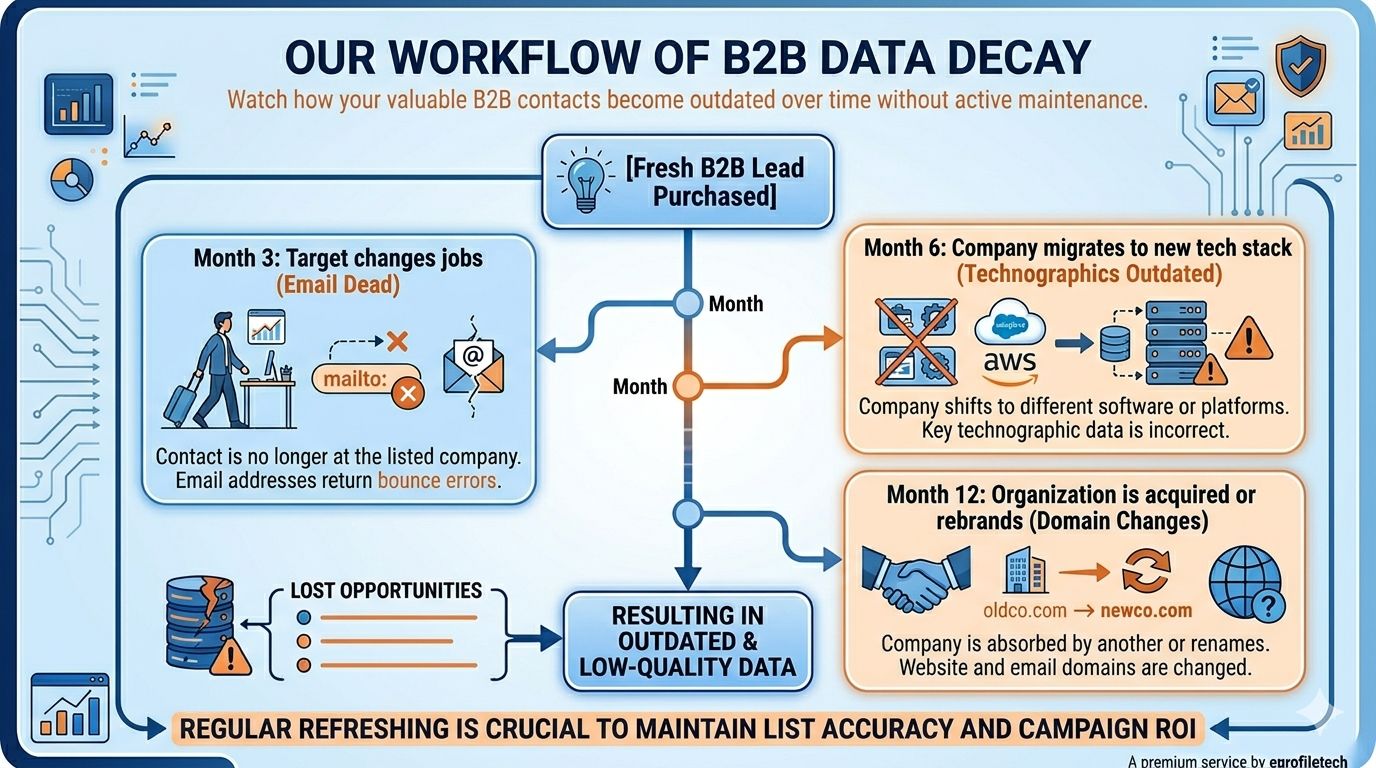
The primary drivers of business data erosion include:
Career Velocity: Professionals change jobs, receive promotions, move departments, or retire. In fast-moving industries like software and healthcare, employee turnover can exceed 25% annually.
Corporate Restructuring: Mergers, acquisitions, and corporate rebrandings instantly invalidate old email domains, company names, and corporate structures.
Technographic Evolution: Companies routinely change their internal software ecosystem. A lead tagged as a “Salesforce User” today may migrate to HubSpot or Microsoft Dynamics next quarter, rendering your tech-stack targeting useless.
Operational Drift: Physical office closures, phone system overhauls, and the transition to remote or hybrid work environments cause corporate phone extensions and mailing addresses to expire.
The Hidden Costs of Poor Data Quality
Data decay is not a minor operational nuisance; it is a direct drain on your company’s revenue. When marketing teams run campaigns using decayed databases, they pay a steep price across multiple areas:
Wasted Marketing Budgets
Most marketing automation and CRM platforms (such as HubSpot, Marketo, and Salesforce) charge tier-based pricing tied directly to the total volume of contacts stored in your database. When 30% of your list consists of invalid, unverified records, you are directly paying to host ghost profiles that cannot convert.
Ruined Sales Productivity
When sales development representatives (SDRs) spend their time dialing broken phone numbers, routing emails to inactive inboxes, or researching prospects who left the company six months ago, sales velocity drops. Your sales team loses trust in marketing data, creating friction between the two departments.
Severe Deliverability Penalties
This is the most critical consequence. Major mailbox providers like Google (Workspace) and Microsoft (Outlook/Office 365) use sophisticated machine-learning algorithms to grade your email sending domain. If your campaigns frequently trigger hard bounces or hit dormant mailboxes, your sender score drops. Once your score falls below a critical threshold, your emails bypass the inbox entirely and land directly in the spam folder.
2. The Core Pillars of Modern Email Deliverability
Many marketers mistakenly believe that hitting the inbox is a matter of writing the perfect subject line or avoiding words like “free” or “buy now.” While content matters slightly, deliverability is fundamentally an infrastructure and reputation game.
Mailbox providers act as digital bouncers for corporate inboxes. Their job is to protect their users from spam, phishing, and irrelevant noise. To ensure your marketing messages pass through their filters, your data marketing team must consistently optimize the three pillars of deliverability:
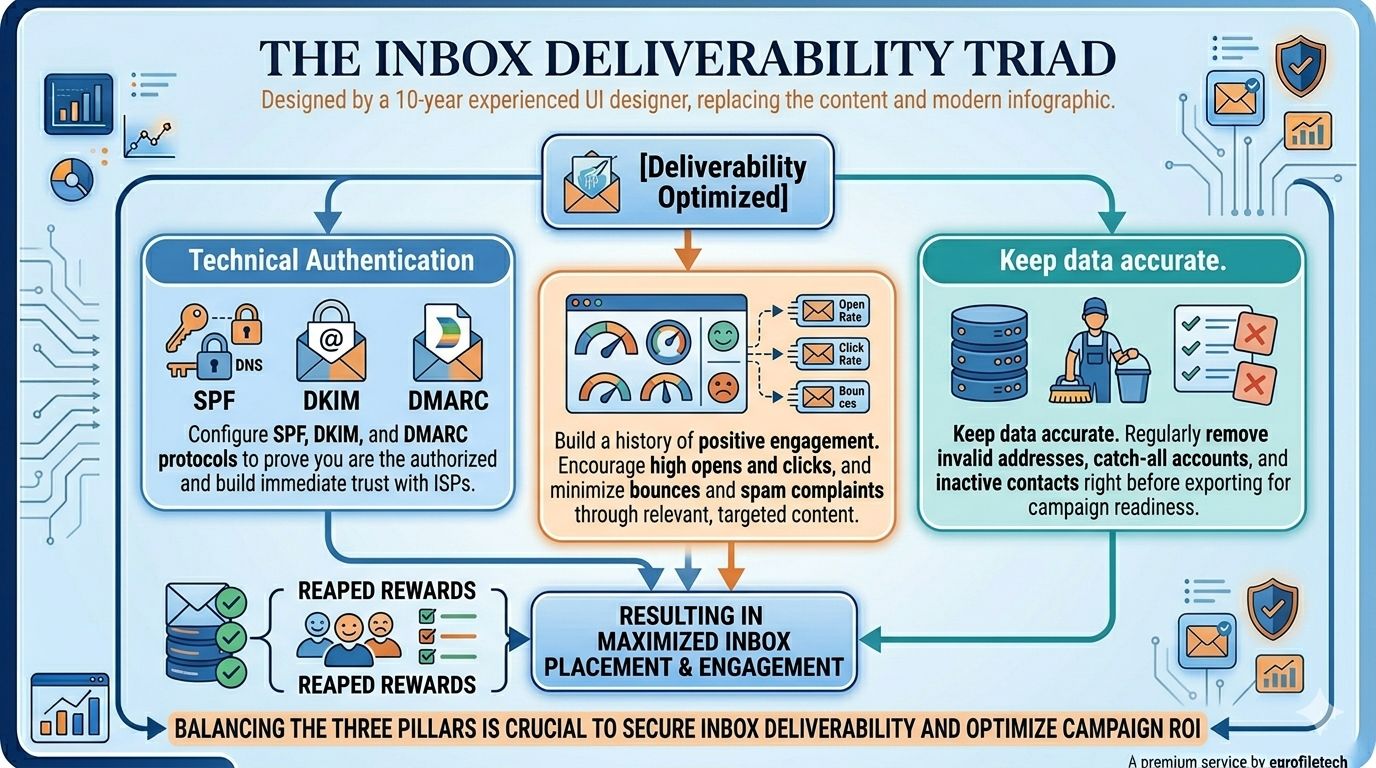
Pillar 1: Technical Authentication
Before sending a single outbound campaign, your IT or Revenue Operations team must configure four core email authentication protocols. Think of these as digital passports that prove your organization actually sent the message.
SPF (Sender Policy Framework)
An SPF record is a public text file added to your domain’s DNS (Domain Name System). It explicitly lists every authorized IP address and server allowed to send emails on behalf of your domain. If an outbound email originates from an IP address not listed in your SPF record, receiving servers view it as highly suspicious.
DKIM (DomainKeys Identified Mail)
DKIM adds a cryptographic, unalterable signature to the header of every email you send. This signature matches a public key published in your DNS records. It guarantees to the mailbox provider that your email was not modified, intercepted, or forged while traveling across the web.
DMARC (Domain-based Message Authentication, Reporting, and Conformance)
DMARC acts as the command center for your authentication policies. It instructs receiving servers exactly how to handle emails that fail SPF or DKIM checks. A strict DMARC policy (such as p=reject or p=quarantine) blocks malicious actors from spoofing your domain, which provides a major trust signal to Google and Microsoft filters.
BIMI (Brand Indicators for Message Identification)
BIMI is an advanced authentication layer that displays your official corporate logo next to your emails inside supported inboxes. To qualify for BIMI, you must have a clean DMARC policy and a verified trademark certificate. This visible token increases open rates by immediately proving authenticity to the recipient.
Pillar 2: Sender Reputation and Behavioral Metrics
Mailbox providers keep a running scorecard on your domain and your sending IP addresses. This scorecard is dynamically adjusted based on how recipients interact with your messages over time:
| Positive Signals (Improves Sender Score) | Negative Signals (Damages Sender Score) |
| High unique open rates | High spam complaint rates (Target: less than 0.1%) |
| Consistent reply and conversation rates | Sustained high hard bounce rates (Target: less than 2.0%) |
| Moving your email from “Promotions” to the primary inbox | High unsubscribe volume relative to list size |
| Forwarding your message to other corporate users | Unopened emails over extended periods (low engagement) |
Pillar 3: Database Cleanliness and Hygiene
The absolute cleanest technical setup will still fail if you send messages to bad data. If you upload a list packed with bad emails, your technical authentication will simply help mailbox providers identify and penalize your domain more quickly. High-quality data is the primary safeguard for your technical infrastructure.
3. Step-by-Step B2B Data Hygiene Workflow
Maintaining a healthy database requires a consistent process. Marketing teams cannot rely on ad-hoc list cleanings once a year. You need a structured data hygiene workflow to clean your database, update missing context, and remove bad leads before they touch live campaigns.
1.Run a Complete Database Audit:Phase 1: Diagnostic Mapping.
Before cleaning anything, extract your historical engagement metrics from your CRM. Segment your entire database into three clear categories based on real behavioral history: Active contacts (interacted within 90 days), Passive contacts (no interaction for 90 to 180 days), and Cold/Inactive contacts (no interaction for greater than 180 days). This structural map isolates your highest-risk segments immediately.
2.Execute Automated Syntax and Format Cleansing:Phase 2: Bulk Structural Validation.
Pass your high-risk and unverified records through an automated validation process. This phase targets simple formatting errors, such as missing “@” symbols, trailing white spaces, invalid top-level domains (e.g., .cm instead of .com), or duplicate entries. Stripping these errors reduces your upfront validation costs before moving to deep verification.
3.Perform Deep Server-Level Email Verification:Phase 3: Real-Time Verification.
Use advanced verification tools to run deep server checks without sending an actual message. This process checks for invalid mailboxes, catch-all server configurations, and known spam traps. It validates that the SMTP server for the target company is active and ready to accept your emails safely.
4.Apply Data Enrichment and Firmographic Appending:Phase 4: Database Modernization.
Once your list is free of dead addresses, match the remaining contacts against a trusted B2B data provider like EProfileTech. Append missing context, such as updated corporate titles, current physical offices, real revenue tiers, and active company technographics. This step transforms basic email rows into rich buyer profiles.
4. Advanced Data Enrichment: Moving Beyond Basic Contact Rows
A modern data marketing team understands that an email address by itself holds limited value. To build high-converting pipelines, your database must be enriched with context. Data enrichment means taking a minimalist record—like a name and an email address—and automatically appending broad business intelligence layers to it.
Firmographics: The Corporate Environment
Firmographics are the organizational equivalent of demographics. They tell you exactly what the target company looks like from an operational perspective:
Employee Headcount: Allows you to segment accounts into small business (SMB), mid-market, or enterprise tiers, ensuring your pricing scales correctly.
Annual Revenue Tracking: Helps prioritize accounts that have the budget to afford your solution.
Exact Geographic Footprint: Essential for localized compliance tracking, field sales distribution, and regional marketing setups.
Vertical Industry Codes: Utilizing standardized codes (such as SIC or NAICS) ensures your content speaks directly to specific industry challenges.
Technographics: The Software Infrastructure
Technographics reveal the exact software application stack running inside your prospect’s organization. Knowing a company uses specific tools allows you to craft highly relevant messages:
Competitive Replacement Campaigns: If your software competes with a specific tool, you can build an automated segment targeting companies running that exact application. Your messaging can address the specific weaknesses of that competitor.
Integration-Led Personalization: If your solution integrates perfectly with a platform like Salesforce or AWS, you can target users of those systems with an explanation of how easily your tool fits into their current workflow.
Digital Maturity Scoring: Assessing a company’s software investments helps determine if they are digitally advanced enough to get value from your high-end enterprise platforms.
5. Regulatory Compliance and Global Privacy Frameworks
Modern data marketing teams must navigate a complex landscape of global privacy laws. Failing to handle data responsibly can result in massive financial penalties and permanent damage to your brand’s reputation.
Compliance is no longer just a legal obligation; it is a critical differentiator for building trust with your prospects.
GDPR (General Data Protection Regulation) – Europe
The European Union’s GDPR is the world’s strictest privacy framework. If you handle data belonging to EU citizens, you must adhere to these clear principles:
-
Legitimate Interest vs. Explicit Consent: While outbound cold outreach is legal under GDPR using the “Legitimate Interest” framework, you must prove your offer is directly relevant to the recipient’s business role. Alternatively, you must secure explicit, documented opt-in consent.
-
The Right to Erasure (“Right to be Forgotten”): If an individual requests to be removed from your database, you must delete their records across all sales tools, analytics platforms, and backup servers within thirty days.
-
Data Minimization: Only collect, process, and retain data points that are absolutely necessary to complete your stated business operations.
CCPA / CPRA (California Consumer Privacy Act) – United States
California leads privacy regulation within the United States. The CCPA applies to businesses targeting California residents and emphasizes user control over how data is sold or shared:
-
The “Do Not Sell My Info” Mandate: Your website must feature a clear, easily accessible link allowing users to opt out of data tracking, sales, and sharing configurations.
-
Notice at Collection: You must inform consumers at or before the point of data collection exactly what categories of personal data you collect and how you plan to use it.
CAN-SPAM Act – United States
The CAN-SPAM Act regulates commercial email across the United States. Unlike European frameworks, it operates on an opt-out basis, meaning you can message prospects without prior consent, provided you follow these specific guidelines:
-
No Deceptive Header Routing: Your “From,” “To,” and routing information must be completely accurate, clearly identifying your identity or company.
-
Honest Subject Lines: Your subject lines must accurately reflect the real content contained within the body of the message.
-
Mandatory Opt-Out Mechanism: Every outbound email must feature a functional, visible unsubscribe link. You must honor all unsubscribe requests within ten business days.
-
Physical Address Footnote: Your email signature or footer must display a valid physical postal address for your business entity.
6. Real-Time Data Verification Architectures
The most efficient way to keep your database clean is to stop bad data from entering your systems in the first place. Relying exclusively on scheduled bulk cleanups means your sales reps will still interact with unverified data between cleaning cycles. Instead, enterprise marketing teams install real-time data verification architectures across all lead generation entry points.
Inbound Forms API Verification
When a user fills out a lead form on your website, your system should instantly validate the email address via API before allowing the submission to complete.
Block Free Email Providers: If your business is strictly B2B, configure your forms to reject generic handles like
@gmail.com,@yahoo.com, or@outlook.com. Prompt the user to enter a valid corporate email address.Instant Syntax Validation: Catch typos instantly (e.g.,
user@gnail.com). The form can display a friendly inline alert: “Did you mean user@gmail.com?”, correcting the error before it hits your database.
Dynamic Data Appending at Point-of-Entry
Long web forms with fifteen fields crush conversion rates. Users simply do not want to fill out extensive forms. By deploying real-time enrichment APIs, you can drastically shorten your forms while capturing rich data profiles.
Short Forms, Deep Data: Design forms that only ask for two fields: Email Address and Company Name.
Silent Enrichment: As soon as the user submits the form, your backend script routes the email through your provider’s API. Within milliseconds, the API retrieves the company’s size, industry, revenue, and location, instantly enriching the lead record before saving it to your CRM. This gives your sales team complete context without hurting your front-end conversion rates.
7. Maximizing Deliverability via Domain Architecture
When running large-scale B2B outbound campaigns, sending thousands of emails from your primary corporate domain (e.g., company.com) is a high-risk strategy. If a campaign triggers a spike in spam complaints, your domain reputation could drop. This would disrupt critical everyday business communications, such as messages to active clients, investor relation emails, and internal team updates.
To protect your business, always separate your marketing outbound channels using a dedicated domain architecture.
The Alternative Domain Strategy
Purchase lookalike domains dedicated exclusively to outbound prospecting and demand generation campaigns. For example, if your primary website is eprofiletech.com, you might acquire:
-
eprofilehq.com -
geteprofiletech.com -
eprofileapp.com
Redirect these alternative domains back to your primary homepage. If a prospect types the sender’s domain into a browser, they land directly on your main website, maintaining a seamless user experience.
The Domain Warm-Up Process
You cannot simply purchase a brand-new domain and immediately send 500 emails a day. New domains have no established reputation with mailbox providers, and sudden volume spikes will trigger automated spam filters. You must systematically “warm up” your domains.
-
Automated Peer Networks: Use specialized warm-up platforms to connect your new domain to a network of real inboxes. These tools send automated messages back and forth, open the emails, move them out of spam folders, and mark them as important.
-
Gradual Scaling: Start by sending 10 to 20 emails per day during the first week. Slowly increase your daily volume over four to six weeks until you reach your target campaign scale. This deliberate ramp-up proves to mailbox providers that your domain is managed by a legitimate business user rather than a malicious spam bot.
💡 The Data Quality Checklist for Marketing Teams
Print out this summary checklist to ensure your marketing team maintains top-tier data hygiene standards every single week:
-
[ ] Weekly: Run automated validation loops on all incoming website leads to catch formatting errors and invalid corporate handles.
-
[ ] Monthly: Track your domain’s health score across Google Postmaster Tools and Microsoft SNDS to spot deliverability issues early.
-
[ ] Quarterly: Partner with an enterprise B2B data provider like EProfileTech to scrub your database, append missing titles, and update technographic shifts.
-
[ ] Bi-Annually: Isolate, test, or safely purge contacts who haven’t opened an email or visited your website in over 180 days to protect your sender score.
Summary: Building a Revenue Engine That Lasts
Data quality is not a static project you complete once and check off your list. It is a continuous operational discipline that separates high-performing growth teams from those struggling with low engagement and broken delivery channels.
By keeping your technical infrastructure authenticated, building a modern alternative domain layout, using real-time enrichment tools, and matching your records against premium verified B2B databases, you protect your sender infrastructure and unlock the full potential of your sales and marketing strategies.
Don’t let your marketing campaigns run on empty data. Keep your lists fresh, keep your delivery rates high, and build a scalable pipeline that converts.
Need to clean your current marketing database or build a hyper-targeted, 100% verified healthcare, technology, or finance email list? Explore custom data solutions at EProfileTech today.
Add a Comment